


Rezente Publikationen
Can “Safety Zones” provide Safety to Critical Submarine Cables?
Natascha Gojkovic
Natascha Gojkovic, ‘Can “Safety Zones” provide Safety to Critical Submarine Cables?’ (EJIL:Talk!, 21 August 2026) <https://www.ejiltalk.org/can-safety-zones-provide-safety-to-critical-submarine-cables/>
The blog post shows that, unlike in the case of artificial islands, installations, and structures, Article 60 of the UNCLOS does not apply to cables, and highlights how states such as Australia, New Zealand, Denmark, and Japan have so far attempted to close this gap through national protection zones. In conclusion, he advocates for an analogous application of Article 60 of the UNCLOS to resolve the resulting legal uncertainty at the level of international law.
Link: https://www.ejiltalk.org/can-safety-zones-provide-safety-to-critical-submarine-cables/

Lieber Studies Indo-Pacific Volume – A Tale of Tenacity, Tensions, and Ambiguity: Mutual Defense Treaties and Defense Groupings in the Indo-Pacific
Erika de Wet
Erika de Wet, 'Lieber Studies Indo-Pacific Volume – A Tale of Tenacity, Tensions, and Ambiguity: Mutual Defense Treaties and Defense Groupings in the Indo-Pacific' (Articles of War, 27 July 2026)
This post draws attention to key issues identified in the chapter entitled “Mutual Defense Treaties and Defense Groupings in the Indo-Pacific Region: An Introduction,” from a recent volume in the Lieber Studies series titled, Armed Conflict and International Law in the Indo-Pacific Region. These issues include ambiguities surrounding the nature of assistance obligations under the respective treaty frameworks, as well as their geographic scope. The post also highlights challenges to the durability of these agreements (illustrated most vividly by the reconfiguration of the ANZUS in 1986), and the risk of competing or overlapping legal obligations as alliances proliferate.
Advisory Proceedings before International Courts and Tribunals with regard to State’s Climate Change Obligations: A Comparative Analysis
Natascha Gojkovic
Natascha Gojkovic, ‘Advisory Proceedings before International Courts and Tribunals with regard to State’s Climate Change Obligations: A Comparative Analysis’, (2026) 29 Austrian Review of International and European Law Online 69.
What obligations do states bear under international law in the face of the climate crisis? This question has recently been the subject of multiple requests for advisory opinions before international judicial bodies, including the International Court of Justice (ICJ), the International Tribunal for the Law of the Sea (ITLOS) and two regional human rights courts – the Inter-American Court of Human Rights (IACtHR) and the African Court on Human and Peoples’ Rights (AfCtHPR). The first request for an AO in this respect was submitted in 2022 by the Commission of Small Island States on Climate Change and International Law to ITLOS. The Tribunal issued its opinion in 2024, addressing the legal implications of climate change within the framework of the international law of the sea. Shortly thereafter, in 2023, the UN General Assembly submitted a separate request to the ICJ. Unlike the more narrowly tailored ITLOS proceedings, the ICJ’s recently delivered advisory opinion adopts a significantly broader perspective, examining the obligations of states under international law as a whole in the context of climate change. The parallel developments raise a series of questions: how do these two advisory proceedings differ in scope, substance, and procedure? To explore this, the article will first undertake a comparative analysis of the advisory jurisdictions of the ICJ and ITLOS. It will then examine the specific procedural frameworks and requirements governing each request, providing a clearer understanding of how international legal mechanisms are evolving to confront the global climate challenge. As a result, fundamental distinctions with respect to the advisory jurisdiction of the two courts and the (supposed) greater flexibility and simplified accessibility of ITLOS are identified.
DOI: https://doi-org.peacepalace.idm.oclc.org/10.1163/15736512-02901004
Anfängerhausarbeit – Öffentliches Recht: Staatsorganisationsrecht – „B muss weg!“
Rareș-David Chioreanu
Rareș-David Chioreanu, “B muss weg!”, JuS 2026, S. 659 ff.
Diese anspruchsvolle Hausarbeit verbindet neue Probleme des Verfassungsprozessrechts mit der klassischen Frage der Abwahl der Bundestagspräsidentin, die infolge neuer Änderungen der GOBT an Aktualität gewonnen hat, und dem Grundsatz der fairen und loyalen Anwendung der Geschäftsordnung.
Mutual Defense Treaties and Defense Groupings in the Indo- Pacific Region: An Introduction
Erika de Wet
Erika de Wet, 'Mutual Defense Treaties and Defense Groupings in the Indo- Pacific Region: An Introduction' ,in Douglas Guilfoyle & Jennifer Maddocks Eds) Armed Conflict and International Law in the Indo-Pacific Region (OUP, 2026) 221-244.
This chapter provides an introductory overview of five enduring defense alliances established in the Indo-Pacific between 1951 and 1971, with the aim of assessing the scope of the legal obligations triggered in the case of an armed attack on an alliance partner. The alliances in question include the ANZUS between Australia, New Zealand, and the United States; the Five Powers Defence Arrangement (FPDA) between Australia, Malaysia, New Zealand, Singapore, and the United Kingdom; and three bilateral alliances between the United States and the Philippines, Japan, and the Republic of Korea, respectively. In furtherance of this aim, the chapter addresses controversies over the geographic scope of each alliance and (in particular in relation to the United States–Japan alliance), the threshold for triggering the right of individual or collective self-defense of alliance partners. It also examines challenges related to alliance durability and competing treaty obligations that may arise from the parallel security arrangements with partially overlapping partners. The chapter concludes by identifying the potential spillover effects of escalating maritime disputes between various alliance partners with the PRC—as well as with each other—on the United States as a major source of future concern.
Winning an Election Doesn’t Give the Right to Disobey: A Rejoinder to Constitutional Disobedience
Rareș-David Chioreanu
Der Beitrag widerspricht der These, ein Wahlsieg legitimiere "verfassungsrechtlichen Ungehorsam" gegen illiberale Ordnungen. Am Beispiel Ungarns wird argumentiert, dass die Missachtung der Verfassung weder rechtlich zulässig noch politisch klug sei. Stattdessen plädiert der Beitrag für Kooperation, institutionelle Kontinuität und schrittweise Reformen, um bestehende, politisch verfestigte Strukturen zu überwinden. Verfassungsrechtlicher Ungehorsam berge das Risiko, demokratische Prinzipien weiter zu untergraben und autoritäre Dynamiken zu verstärken.

A Critical Look at the Implicit Messages in the CDDH Outcome Document with Elements for the Chișinău Declaration
Wolfgang Benedek
Der Beitrag untersucht das Ergebnisdokument des CDDH im Hinblick auf die geplante Chișinău-Erklärung. Im Fokus stehen die impliziten Botschaften zum Verhältnis von Menschenrechtsschutz, staatlicher Souveränität und Migration. Während das Abschlussdokument formal an bestehenden Standards festhält, deutet seine Ausrichtung auf eine restriktivere Interpretation der EMRK hin. Insbesondere gewinnen sicherheits- und migrationspolitische Erwägungen an Gewicht. Der Beitrag warnt, dass diese Verschiebung das Schutzniveau der Konvention untergraben und mittelbar Einfluss auf die Rechtsprechung des Europäischen Gerichtshofs für Menschenrechte nehmen könnte.

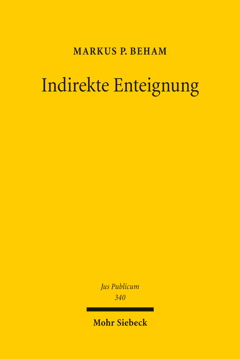
Indirekte Enteignung
Markus P. Beham (Tübingen 2026)
Das Bundesverfassungsgericht hat mit dem Nassauskiesungsbeschluss einen streng formellen Enteignungsbegriff etabliert. Staatliche Maßnahmen unterfallen diesem nicht, wenn es etwa am Element der Güterbeschaffung fehlt. Folge ist, dass anders als bei der Enteignung auch grundsätzlich kein Entschädigungsjunktim besteht. Dieser Auffassung setzt der Autor eine Neuinterpretation der Eigentumsgarantie entgegen, die sich einerseits auf den Wortlaut des Grundgesetzes, andererseits im Sinne der »offenen Staatlichkeit« auf die Normen des Völker- und Europarechts, ebenso wie auf rechtsvergleichende Überlegungen stützt. Markus P. Beham plädiert damit nicht nur für einen materiellen Enteignungsbegriff, sondern für eine aus dem Mehrebenensystem heraus verstandene, offene Anwendung innerstaatlichen Rechts.
28. Band des Max Planck Yearbook on United Nations Law
Kuratiert von den Chefredakteurinnen Prof. Dr. Erika de Wet und Dr. Kathrin Maria Scherr sowie dem leitenden Chefredakteur Sai Sathyanarayanan Venkatesh. Die Max Planck Foundation und Brill sind gemeinsame Herausgeber des Bandes. Die Printversion erscheint im Jänner 2026.
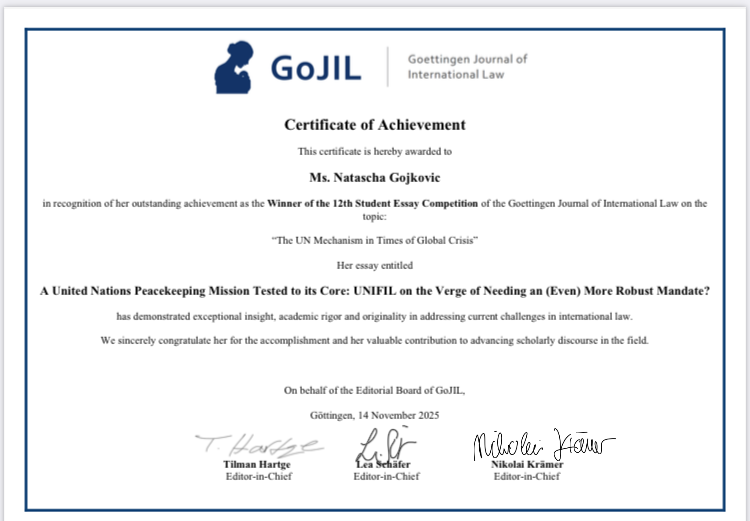
A UN Peacekeeping Mission Tested to Its Core
Natascha Gojkovic, A United Nations Peacekeeping Mission Tested to its Core: UNIFIL on the Verge of Needing an (Even) More Robust Mandate? Goettingen Journal of International Law (2025) (Pre-Published Article) 1-23.
https://journals.uni-goettingen.de/gojil/article/view/2596/2251
Is There a Need for New Digital Human Rights in AI Governance?
Wolfgang Benedek, Is There a Need for New Digital Human Rights in AI Governance? in Tiina Pajuste (ed), Human Rights in the Digital Domain - Core Questions (Cambridge University Press 2025) 19-39.
Open access at https://doi.org/10.1017/9781009606295

Staatenimmunität: OGH bestätigt Zweck-Betrachtung bei Arbeitnehmerklagen
Lisa Seyfried, Staatenimmunität: OGH bestätigt Zweck-Betrachtung bei Arbeitnehmerklagen, ecolex 2025/233, https://rdb.manz.at/document/rdb.tso.ENecolex20250620
Secessionist Entities and International Law
Benedikt Harzl, Secessionist Entities and International Law. The South Caucasus Disputes between Self-Determination, Territorial Integrity, and the Quest for a European Engagement Policy (Brill 2025)
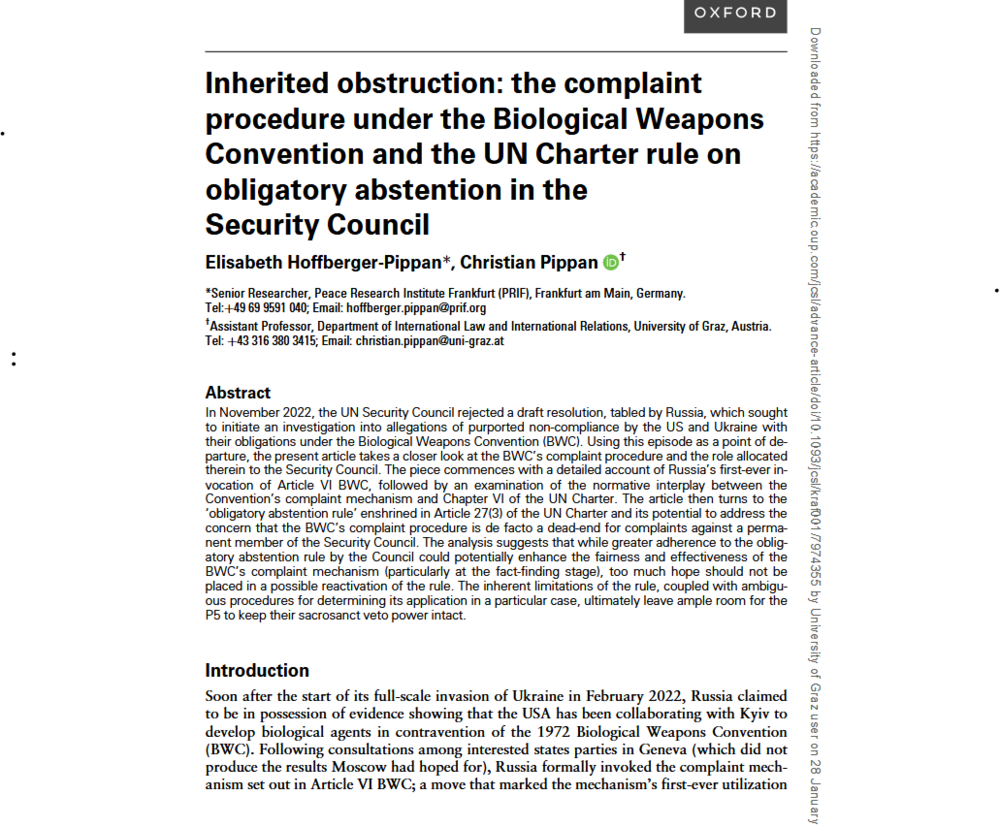
The Complaint Procedure Under the Biological Weapons Convention and 'Obligatory Abstention' in the UNSC
Elisabeth Hoffberger-Pippan and Christian Pippan, Inherited Obstruction: The Complaint Procedure Under the Biological Weapons Convention and the UN Charter Rule on Obligatory Abstention in the Security Council, 30 Journal of Conflict & Security Law (2025) 1–18.
27. Band des Max Planck Yearbook on United Nations Law
Kuratiert von den Chefredakteurinnen Prof. Dr. Erika de Wet und Dr. Kathrin Maria Scherr sowie dem leitenden Chefredakteur Sai Sathyanarayanan Venkatesh. Die Max Planck Foundation und Brill sind gemeinsame Herausgeber des Bandes. Die Printversion erscheint im Jänner 2025.

Cooperation à la Carte? (Verfassungsblog)
Hörzer, Anna Lena: Cooperation à la Carte?: Austria’s Stance on Head of State Immunities and Cooperation, VerfBlog, 2024/8/23, verfassungsblog.de/austria-icc-arrest-warrants/, DOI: 10.59704/429964295a694d1f
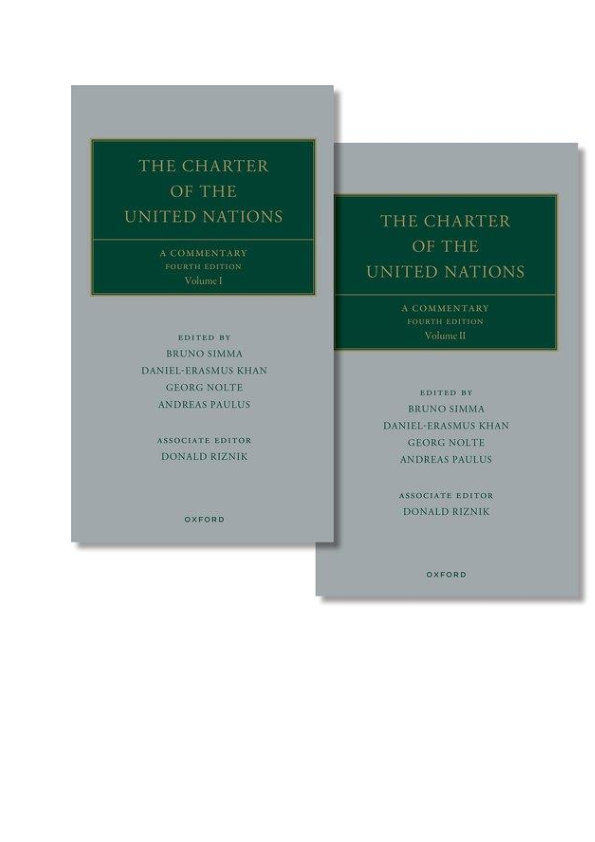
Bruno Simma et al (eds), The Charter of the United Nations. A Commentary (4th ed, OUP 2024) - Beiträge von Erika de Wet und Helmut Tichy
Commentaries by Erika de Wet: ‘Introduction to Chapter VII: The General Framework’, ‘Article 39’, ‘Article 40’, ‘Article 41’, ‘Article 42’, and (with Nico Krisch) ‘Article 43’.
Commentary by Helmut Tichy (with Philip Bittner): ‘Article 15’.
Erika de Wet: The beginning of a world tour
Erika de Wet erinnert sich an ihren Aufenthalt am Max-Planck-Institut für ausländisches öffentliches Recht und Völkerrecht in den 1990er Jahren; MPIL 100 Blog (24.05.2024)

Sustainability of the Exploration and Use of Outer Space
Yvonne Karimi-Schmidt (ed), Sustainability of the Exploration and Use of Outer Space, Commemorative book (Springer 2024) 65 pp.
Die völkerrechtlichen Grundlagen von Sanktionen
Erika de Wet und Christina Seewald, Die völkerrechtlichen Grundlagen von Sanktionen: ein rechtsquellenorientierter Überblick unter besonderer Berücksichtigung der restriktiven Maßnahmen der EU gegen Russland, ZÖR 79 (2024) 101-128.
26. Band des Max Planck Yearbook on United Nations Law
Kuratiert von den Chefredakteurinnen Prof. Dr. Erika de Wet und Dr. Kathrin Maria Scherr sowie dem leitenden Chefredakteur Sai Sathyanarayanan Venkatesh. Die Max Planck Foundation und Brill sind gemeinsame Herausgeber des Bandes. Die Printversion erscheint im Frühjahr 2024.
Max Planck Encyclopedia of International Law
Erika De Wet and Michael Wood, 'Collective Security' (last updated July 2023), in Anne Peters and Rüdiger Wolfrum (eds), The Max Planck Encyclopedia of Public International Law (Oxford University Press 2008–) <www.mpepil.com>.
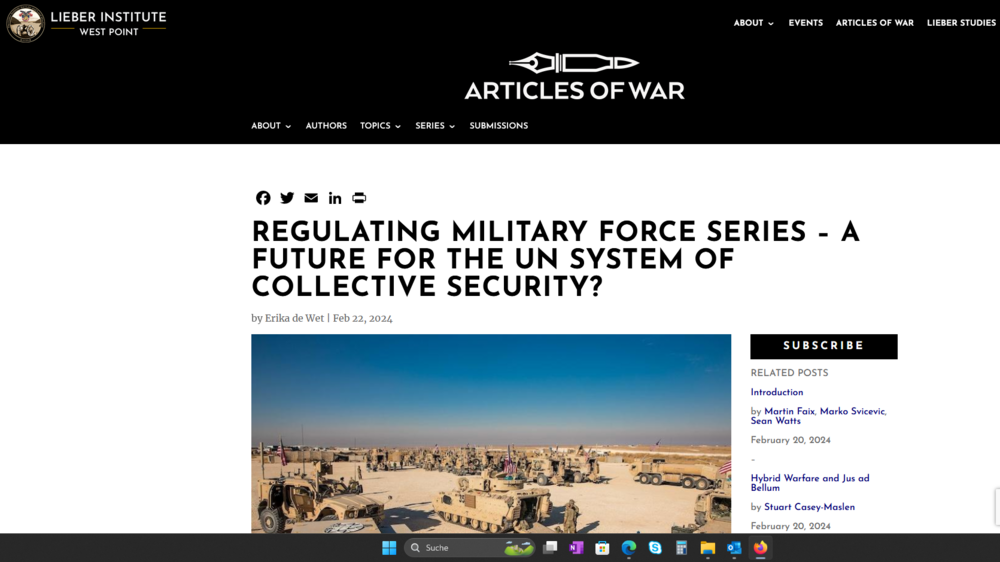
Regulating Military Force Series (Lieber Institute)
Erika de Wet, A Future for the UN System of Collective Security? Lieber Institute - Articles of War (22 February 2023) <https://lieber.westpoint.edu/articles-of-war>
The Military Law and the Law of War Review
Martha M Bradley, Revisiting and reimagining scholarly approaches: Assessing the notion of intensity in complex non-international armed conflicts through aggregation, The Military Law and the Law of War Review 61 (2023) 2, 160–190.
European Yearbook on Human Rights 2023
Philip Czech, Lisa Heschl, Karin Lukas, Manfred Nowak, Gerd Oberleitner, European Yearbook on Human Rights 2023 (Larcier Intersentia 2023)
Entrenching International Values through Positive Law: The (Limited) Effect of Peremptory Norms
Erika de Wet, ‚Entrenching International Values through Positive Law: The (Limited) Effect of Peremptory Norms’, in Heike Krieger & Andrea Liese (eds), Tracing Value Change in the International Legal Order (OUP 2023) 85-99.
The War in Ukraine from a Human Security Perspective
Wolfgang Benedek, 'The War in Ukraine from a Human Security Perspective', Peace Human Rights Governance 7 (2023) 1, 9-22.
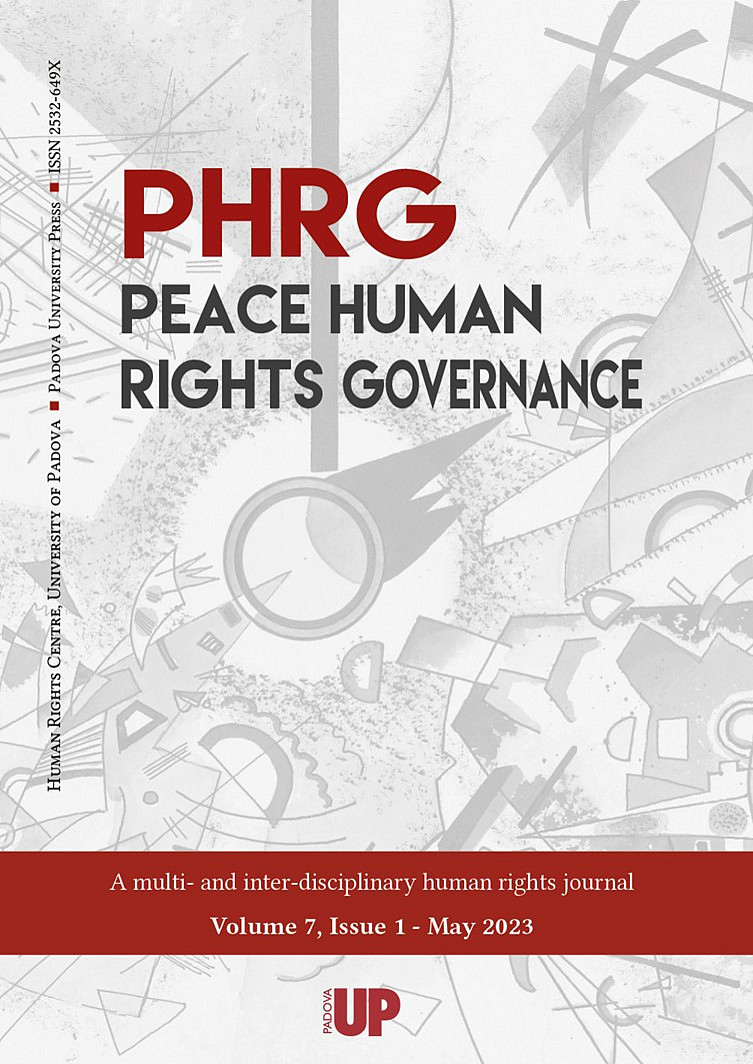
Völkerrecht und „pro-demokratischer“ Interventionismus
Christian Pippan, Pro-democratic Interventionism Revisited, in Daniel Erasmus Khan, Evelyne Lagrange, Stefan Oeter and Christian Walter (eds), Democracy and Sovereignty: Rethinking the Legitimacy of Public International Law (Brill 2023) 35 – 59.
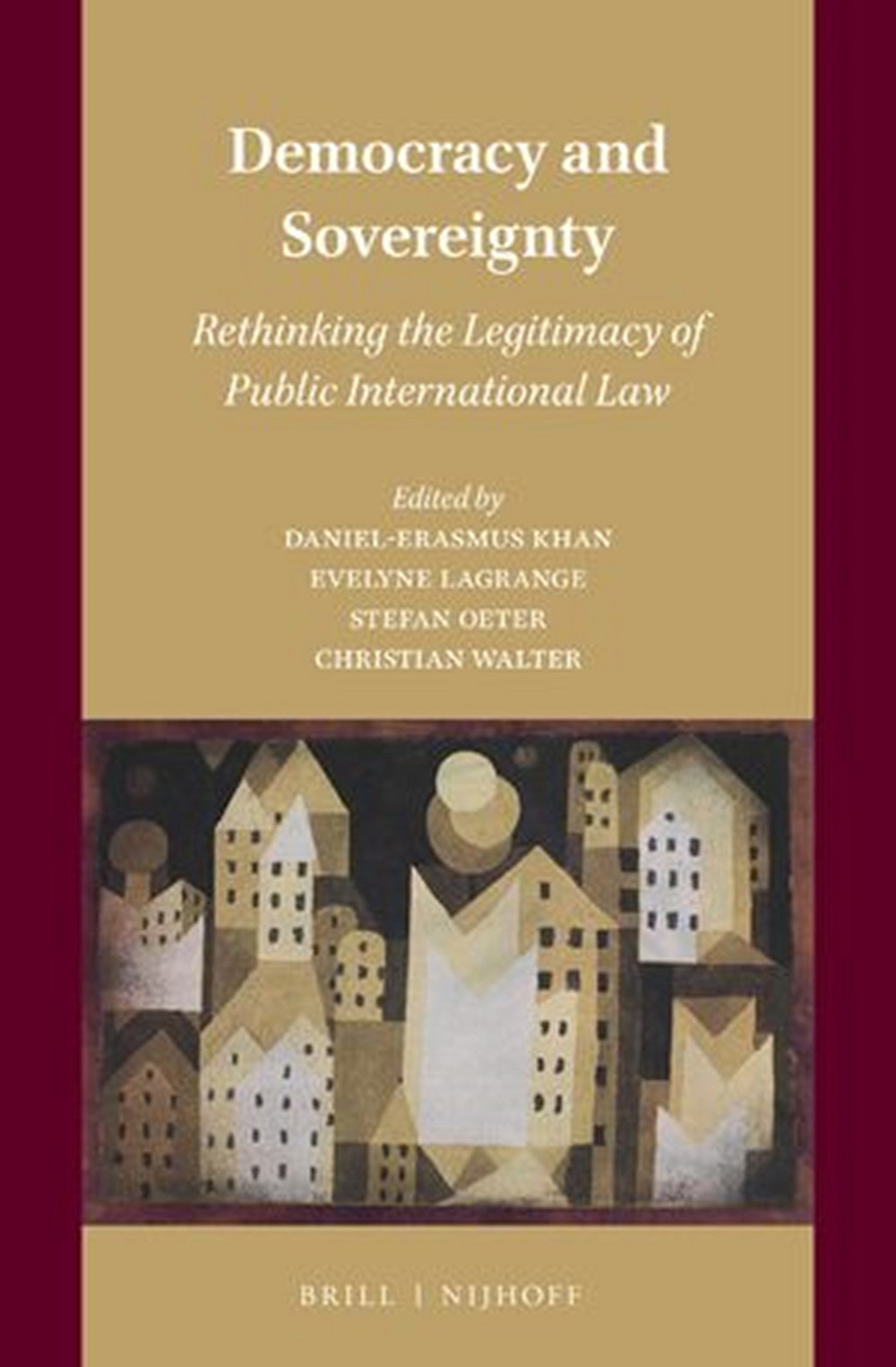
Research Handbook on International Law and Human Security
Gerd Oberleitner (ed), Research Handbook on International Law and Human Security (Edward Elgar 2022)
Rahmenübereinkommen zum Schutz nationaler Minderheiten
Gerhard Hafner, Framework Convention on National Minorities, in Christina Binder, Manfred Nowak, Jane Hofbauer and Philipp Janig (eds), Elgar Encyclopedia of Human Rights (Edward Elgar 2022)

Das Seerechtsübereinkommen der Vereinten Nationen von 1982: Überlegungen nach 40 Jahren
Gerhard Hafner und Helmut Türk, The United Nations Convention on the Law of the Sea, 1982: Reflections after 40 Years, Ocean Yearbook 36 (2022), 3 – 47.

Schutz der Umwelt: eine Verpflichtung erga omnes?
Gerhard Hafner, Protection of the environment: An erga omnes obligation? in: Peter Hilpold, Walter Steinmair und Andreas Raffeiner (Hg.), Österreich und die EU im Umbruch – Eine Nachlese zur Festschrift für Heinrich Neisser (facultas 2022), 195 – 201
Wolfgang Benedek, Veronika Bilkova and Marko Sassoli, Summary of the report of the expert mission under the OSCE Moscow Mechanism, EJIL: Talk! (April 19, 2022)
Rechtswissenschaftliche Fakultät
RESOWI, Universitätsstraße 15/AE, 8010 Graz